


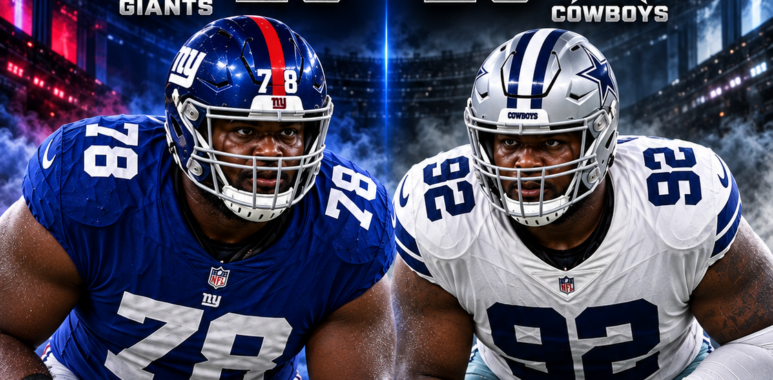
GIANTS OWN THE TRENCHES: NEW YORK DEFEATS DALLAS 28–20
SUFRB NFL Trench Report | Week 1
EAST RUTHERFORD, N.J. — The final score read New York Giants 28, Dallas Cowboys 20, but the numbers inside the box score revealed where this NFC East battle was truly decided: up front.
New York established control behind an offensive line that generated 165 rushing yards, helped produce 394 total yards and kept the offense on the field for 36 minutes and 40 seconds. Dallas finished with 244 total yards, 69 rushing yards and only 23:20 of possession. The Giants did more than win the game—they controlled its pace, physicality and closing moments from the line of scrimmage.
New York’s Offensive Line Sets the Standard
The Giants’ offensive front delivered one of Week 1’s most complete performances.
New York averaged 4.5 yards per rushing attempt and converted nine of its first 10 third-down opportunities. Those numbers reflect consistent movement at the point of attack, disciplined communication and the ability to execute when Dallas knew a run or short-yardage play was coming.
The pass protection was equally effective. Behind the Giants’ front, New York completed 23 of 29 passes for 230 yards, three touchdowns and no interceptions. The 79.3% completion rate demonstrated how consistently the offensive line created workable pockets and prevented Dallas from disrupting the timing of the offense.
Most importantly, New York’s line finished the game.
With the Giants protecting an eight-point lead, the offense took possession with 5:16 remaining. Dallas never touched the football again. New York drained the entire clock by repeatedly winning at the line of scrimmage and converting the downs necessary to secure the victory.
That is finishing football.
SUFRB Offensive Lineman of the Game: Andrew Thomas
Andrew Thomas | Left Tackle | No. 78 | New York Giants
Andrew Thomas earns the SUFRB Offensive Lineman of the Game recognition as the veteran anchor of the unit that powered New York’s 165-yard rushing performance.
Thomas entered the game as one of the Giants’ captains and helped set the physical standard for a line that remained organized against Dallas’ rebuilt defensive front. His influence extended beyond one isolated block or individual statistic. It appeared in New York’s third-down dominance, offensive balance and ability to control the final five minutes.
Offensive linemen are frequently judged by sacks or pressures allowed, but complete line play involves much more. It requires communication, leverage, assignment discipline, combination blocks and the conditioning to execute when everyone in the stadium knows the offense intends to run the football.
Thomas and the Giants’ offensive line delivered in each of those areas.
Quinnen Williams Creates Dallas’ Biggest Defensive-Line Play
Although Dallas struggled to stop New York consistently, defensive tackle Quinnen Williams produced the Cowboys’ most important defensive-line moment.
Williams finished with two total tackles and one forced fumble. His takeaway was created through exceptional effort, as he pursued the play from behind and punched the football loose before Dallas recovered it.
That play demonstrated why defensive linemen must continue pursuing even when the action initially moves away from them. Williams did not surrender after the ball crossed the line of scrimmage. His effort created a possession-changing turnover and briefly gave Dallas an opportunity to shift the momentum.
For that reason, Williams receives the SUFRB Defensive Lineman of the Game recognition.
Giants’ Defensive Front Wins Without a Sack
New York’s defensive-line performance proved that domination is not measured exclusively through sacks.
The Giants did not record a sack, but their front limited Dallas to 69 rushing yards on 18 attempts—just 3.8 yards per carry. New York consistently reduced interior running lanes, maintained gap integrity and forced Dallas away from the type of balanced offensive approach needed to control the game.
The most significant defensive-line statistic was not an individual total. It was Dallas’ inability to establish sustained possession. The Cowboys ran only two offensive possessions during the second half. Although both ended with points, the limited opportunities resulted directly from New York controlling the football and winning the battle between the tackles.
Dallas’ Offensive Line Could Not Control the Pace
Dallas’ offensive line showed moments of stability, particularly after halftime, but the unit never established consistent command of the line of scrimmage.
The Cowboys averaged 3.8 yards per rushing attempt and finished with 150 fewer total yards than New York. The offense produced only 69 rushing yards and failed to create enough early-down success to keep the Giants’ offense off the field.
Dallas’ front did make adjustments during the second half, but by then New York had already established the physical identity of the game. The Cowboys were forced to chase the scoreboard while the Giants continued shortening the contest through sustained possessions.
The SUFRB Final Word
The Giants’ 28–20 victory was a reminder that football games are still decided by leverage, movement, communication and execution at the line of scrimmage.
New York’s offensive line created 165 rushing yards, supported an efficient passing performance, converted nine of its first 10 third downs and closed the game by controlling the final 5:16. The Giants’ defensive front answered by limiting Dallas to 69 rushing yards and preventing the Cowboys from establishing their preferred pace.
Andrew Thomas represented the consistency and leadership of the winning offensive front. Quinnen Williams supplied Dallas’ biggest defensive-line play through relentless pursuit and a forced fumble.
For young offensive and defensive linemen watching across the country, this game provided a valuable lesson: impactful trench play is not always captured by one highlight. Sometimes dominance is revealed through possession time, third-down efficiency, rushing production and the ability to finish.
The Giants won the scoreboard—but they conquered the game up front.
It All Starts Up Front.
Statistics verified through the official New York Giants game analysis, Dallas Cowboys recap and Quinnen Williams game statistics.
