


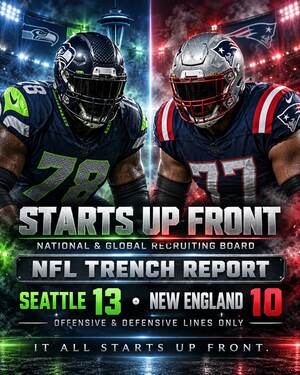
NFL: TRENCH REPORT: 49ers 27, Rams 7
San Francisco Won This Game Before the Ball Ever Got to a Skill Position
Starts Up Front | Week 1 | Thursday, September 10, 2026 | SoFi Stadium
Twenty points separated these two teams. Zero sacks were recorded by either defense. If you only read the scoreboard, you missed the game. Read the line of scrimmage instead.
The Number That Tells the Whole Story
Yards before contact: San Francisco 130. Los Angeles 84.
That is not a ball-carrier statistic. That is blocking statistics. Yards before contact measures one thing only — how much clean grass the five men up front created before anybody in a different colored jersey got a hand on the runner.
San Francisco’s offensive line built 130 yards of clean grass on 30 carries. The Rams built 84 on 29 carries. Nearly identical volume. A 46-yard gap in creation.
Control the trenches. Control the game.
Offensive Line Report: San Francisco
The 49ers front put together the kind of performance we teach at every SUF camp.
• 30 rush attempts, 174 yards, 5.8 per carry
• 0 tackles for loss allowed
• 0 sacks allowed
• 10 rushing first downs
• 18-yard long run
• 33:50 time of possession
Read that second line again. Thirty carries. Zero negative runs. Not one snap where a defensive lineman crossed the face of a blocker and got into the backfield. That is technique, not talent. That is hand placement, first-step quickness, and five men climbing to the second level on the same landmark.
The pass protection number is just as loud: zero sacks allowed, two quarterback hits surrendered, average pocket time of 2.22 seconds. The 49ers did not need a long pocket. They needed a clean one. They got it on 34 drop backs.
Time of possession is an offensive line statistic. San Francisco held the ball for 33 minutes and 50 seconds. Their front kept the defense on the sideline and the opposing defensive line on the field. Fourth quarter, that bill comes due.
Offensive Line Report: Los Angeles
The Rams front was not overwhelmed. It was out-leveraged.
• 29 rush attempts, 122 yards, 4.21 per carry
• 2 tackles for loss allowed (-2 yards)
• 0 sacks allowed
• 7 rushing first downs
• 8 quarterback knockdowns surrendered
• 13-yard-long run
Here is the honest evaluation. The Rams protected the passer and still lost their pocket. Zero sacks on 28 drop backs is real work. But eight knockdowns mean the quarterback hit the ground eight times after the throw. The ball came out at an average of 2.42 seconds — two-tenths of a second longer than San Francisco needed — and that gap is exactly where the hits lived.
Four penalties for 43 yards against two for 21. Discipline is a trench statistic too.
Defensive Line Report: San Francisco
This is the film to study.
- 8 quarterback hits
• 2 tackles for loss
• Only 3 blitzes called all game
• 2 fourth-down stops
• 1 forced fumble, 1 fumble recovery
Eight quarterback hits on three blitzes. San Francisco pressured the passer with four men and dropped seven behind it. Their defensive line did not need help. It did not need exotic pressure packages. It needed one-on-one wins, and it got them all night.
That is the highest compliment you can pay a defensive front. When your coordinator can call four-man rush on third down and walk away, you have a defensive line — not a group of defensive linemen.
Two fourth-down stops. Both at the point of attack.
Defensive Line Report: Los Angeles
- 2 quarterback hits
• 1 tackle for loss
• 4 blitzes called
• 0 sacks
The Rams sent more and got less. Four blitzes produced two quarterback hits. San Francisco’s three blitzes produced eight. When a defense has to manufacture pressure and still cannot generate it, the front four is the problem statement.
One tackle for loss on 30 opponent carries. San Francisco’s offensive line never let a Rams defensive lineman into the backfield on a run play. Not once.
What Our Linemen Take from This Tape?
- The scoreboard is a lagging indicator. The line of scrimmage is a leading one. San Francisco’s front established a 46-yard edge in yards before contact and a 6-to-2 edge in quarterback hits. The 20-point margin was the receipt, not the transaction.
- Zero sacks does not mean you won the rep. The Rams surrendered no sacks and eight knockdowns. Grade yourself on whether the pocket was clean, not just whether the quarterback stayed upright.
- Four-man pressure is the ceiling of defensive line development. If you can win one-on-one, your defense gets to play eleven-on-eleven. If you cannot, your defense has to gamble. Every rep on the sled, every hand-fighting drill, every get-off rep is an investment in that one number.
- Zero tackles for loss allowed on thirty carries is standard. Write it down. That is the target.
It All Starts Up Front.
Starts Up Front is a Chicago-based recruiting and development organization built exclusively for offensive and defensive linemen. Note: box score data reports trench production at the unit level; individual offensive and defensive line splits are not broken out in the official game statistics.
